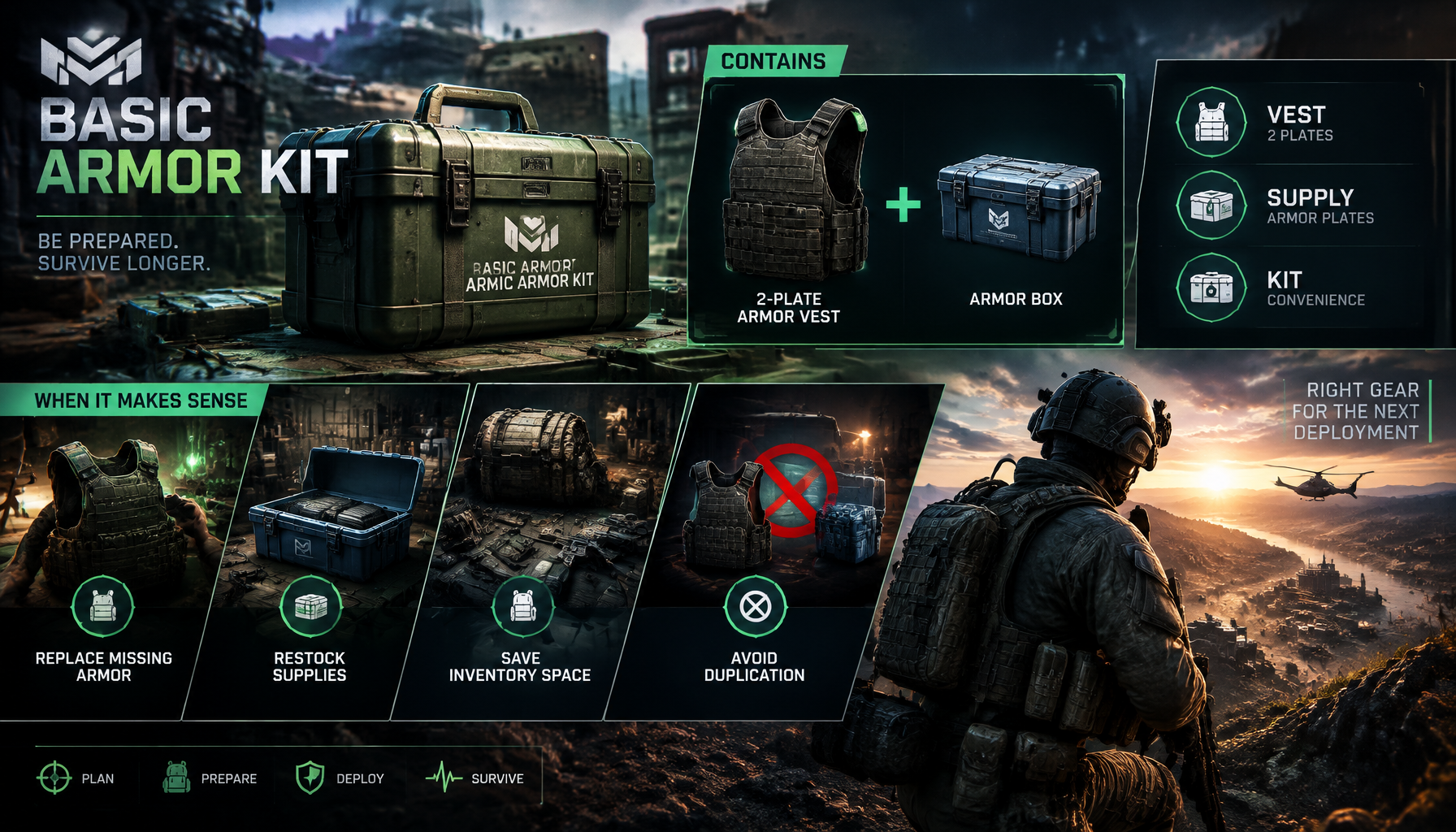
Preparing for a deployment in Call of Duty: Modern Warfare 4 DMZ requires careful decisions about equipment, available supplies, and inventory space. The Basic Armor Kit is an Uncommon consumable that contains a 2-Plate Armor Vest and an Armor Box, combining two armor-related items in a single package. When planning a CoD MW4 Bot Lobby session alongside DMZ activities, keeping equipment choices focused on their actual in-game purpose helps maintain a clear distinction between practice objectives and deployment preparation.
What the Basic Armor Kit Contains
The Basic Armor Kit has a straightforward purpose. According to the DMZHub item database, the package contains two components: an Armor Box and a 2-Plate Armor Vest. The vest provides slots for two armor plates, while the Armor Box serves as an armor supply option. These functions are related, but they are not interchangeable.
The distinction matters when reviewing an existing loadout. An operator who already has a suitable carrier may not need another vest, while someone preparing an equipment set from scratch may find the combination more convenient. The Armor Box also needs to be evaluated separately because its usefulness depends on the available armor supply options and the demands of the planned deployment.
The kit should not be treated as an armor upgrade that automatically improves every aspect of protection. Its listed contents establish what it provides, but they do not establish additional plate capacity, special damage resistance, or any unique defensive effect beyond those components.
Comparing the Kit With Its Individual Components
The most useful way to evaluate the Basic Armor Kit is to compare the package with the functions of its individual contents. This avoids confusing convenience with improved performance and helps identify situations in which carrying the combined item makes sense.
| Item | Confirmed Function | Main Consideration |
|---|---|---|
| Basic Armor Kit | Contains an Armor Box and a 2-Plate Armor Vest | Useful to consider when both components are needed |
| 2-Plate Armor Vest | Provides slots for two armor plates | Check whether the operator already has a suitable carrier |
| Armor Box | Provides an armor supply option | Consider the squad’s expected armor needs and available alternatives |
The kit’s advantage is the combination of its contents, not a confirmed increase in armor strength. If both components are required, the package offers a straightforward preparation option. If one component is unnecessary, the operator should consider whether the kit still fits the available inventory and the intended mission.
When to Carry the Basic Armor Kit
The decision depends on the equipment already available and the objective planned for the next deployment. Operators preparing for an extended operation may want to account for armor replenishment, while a short mission with limited inventory space may call for a more selective loadout. Neither situation automatically makes the kit essential.
Several checks can help determine whether it belongs in the loadout:
- Existing equipment: Check the current carrier before selecting the kit. If the operator already has an appropriate vest, the additional carrier may offer limited immediate value.
- Armor supply needs: Consider whether an Armor Box addresses a genuine requirement. Its usefulness depends on the available replenishment options and the likelihood of needing additional plates.
- Inventory priorities: Compare the kit with other items required for the objective. Medical supplies, ammunition, mission equipment, and valuable loot may compete for limited carrying capacity.
- Deployment conditions: Consider the expected route, the likelihood of sustained combat, and whether the squad can use its armor supplies safely between engagements.
These factors provide a more practical basis for selection than rarity alone. Uncommon classification describes the item’s database category; it does not establish that the kit is more effective than every alternative or that it should be carried on every deployment.
Avoiding Redundant Armor Equipment
Loadout efficiency depends on identifying what each item contributes. Carrying multiple items with overlapping functions can reduce the space available for mission-specific supplies, particularly when the operator has not yet established which resources will be needed during the operation.
The Basic Armor Kit presents a simple example. Its vest and Armor Box serve separate roles, so the package should be evaluated against the equipment already available rather than selected automatically. If the carrier requirement is already covered, the decision becomes whether the Armor Box justifies carrying the kit. If additional armor supplies are not a priority, another item may better support the mission.
This does not mean that duplicate equipment is always wasteful. A squad facing repeated engagements may have a reason to carry additional supplies, provided the game allows the intended inventory arrangement. The relevant question is whether the extra equipment addresses a real need and whether its benefits justify the space and other resources involved.
Players should also distinguish between a carrier’s plate capacity and the availability of reserve plates. A 2-Plate Armor Vest provides two plate slots, but that description alone does not establish how many reserve plates an operator can carry or whether an Armor Box changes the carrier’s capacity. Those mechanics should be checked independently in the current game build.
Basic Armor Kit and Deployment Planning
The kit is best considered during the final loadout review rather than treated as a universal recommendation. Before deployment, check the operator’s existing carrier, available armor supplies, mission requirements, and remaining inventory space. This makes it easier to identify whether the package solves a specific preparation problem or simply duplicates equipment already covered.
During an operation, armor decisions also depend on timing. Replenishing supplies may be sensible after an engagement, but attempting to use an Armor Box in an exposed position can create unnecessary risk. The item’s presence does not remove the need to find suitable cover, monitor nearby threats, or coordinate with teammates.
The same principle applies to extraction planning. Carrying the kit does not guarantee a successful deployment, and no single consumable can compensate for poor positioning or an avoidable engagement. Its value remains tied to the role it plays within the overall equipment plan.
Making an Informed Equipment Choice
The Basic Armor Kit is a practical combination of a 2-Plate Armor Vest and an Armor Box, rather than a specialized piece of high-end protection. Its relevance depends on whether the operator needs both components and whether carrying them fits the mission’s equipment requirements. Comparing the package with the existing loadout provides a clearer answer than assuming its rarity makes it essential.
The Basic Armor Kit is best understood as a convenient way to prepare essential armor supplies before deployment, rather than a substitute for sound equipment management. Checking the included vest and Armor Box, avoiding unnecessary duplication, and leaving enough room for mission-critical items can make loadout preparation more efficient. Players researching buy CoD MW4 Bot Lobby should evaluate that separate service option independently, while keeping in-game equipment decisions focused on survival, resource use, and the demands of each deployment.