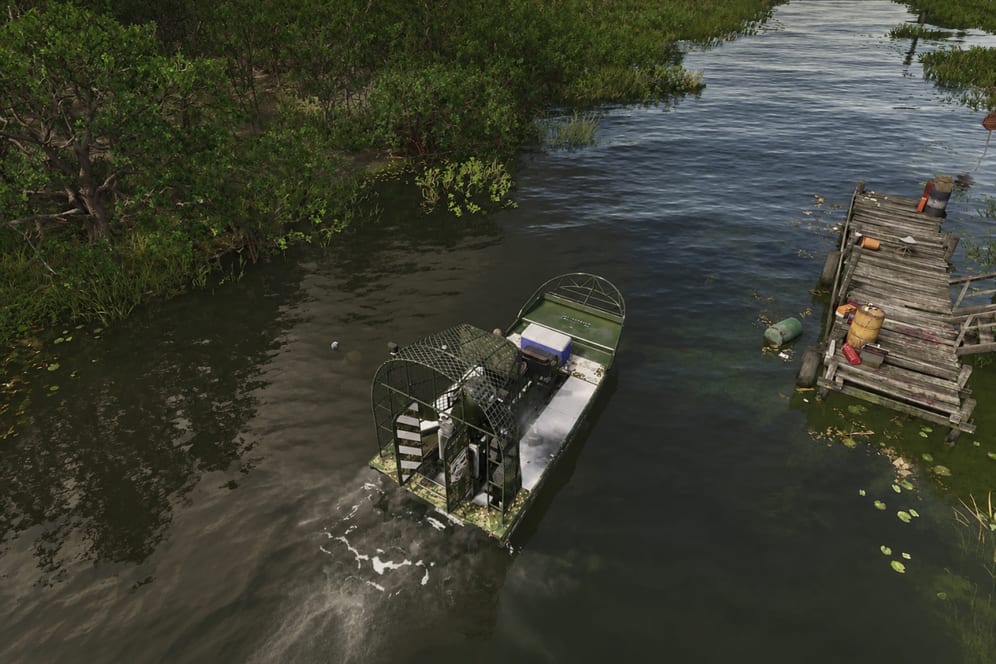
Grassrivers’ published imagery places airboats among marsh vegetation, winding waterways, and alligators. That setting gives airboat exploration a distinct focus: reading narrow channels, judging clearance around vegetation, and keeping track of a return route when several openings look alike.
For players planning exploration around GTA 6 Money goals, route knowledge should come before spending decisions. Promotional footage alone does not establish an airboat’s purchase price, ownership requirements, or operating costs, so those details should stay out of any budget until confirmed.
The available imagery establishes the setting, but it does not provide a tested handling model. The techniques below are practical checks for exploring unfamiliar water. Exact controls, stopping distances, collision behavior, and wildlife reactions require direct gameplay verification.
What the Airboat’s Design Actually Tells You
A Shallow Hull Does Not Confirm Every Surface Is Passable
The airboat shown in GTA 6 has a broad hull and a large caged propeller behind the seating area. Its appearance explains the vehicle’s association with marsh travel, but appearance alone cannot establish its capabilities.
Do not assume the craft can cross exposed mud, slide over every patch of vegetation, or travel across dry ground. A surface that looks like shallow water from a distance may conceal a bank or an obstruction.
When assessing a possible passage, look for:
- A visible water opening extending beyond the entrance.
- Enough clearance for the entire hull.
- Space to correct your approach.
- An identifiable exit or somewhere to turn back.
A narrow gap is useful only if the boat can continue through it or withdraw safely.
Establish Handling Before Entering Confined Water
Use a clear stretch of water to check the controls displayed by the game. Avoid assigning car-like behavior to a boat input without testing it.
| Check | What to observe | Why it matters in the swamp |
| Brief acceleration | How the craft responds to throttle | Helps you approach small openings deliberately |
| Releasing the throttle | How far the boat continues moving | Gives you a reference before blind bends |
| Gentle steering | How heading and travel direction change | Helps you judge clearance beside banks |
| Slowing or reverse input | What the displayed control actually does | Establishes a way to withdraw from a poor approach |
| Turning around | How much open space the maneuver uses | Helps you assess whether a branch offers an exit |
Repeat a check if the result is unclear. A single turn in open water is more informative than guessing how the boat will respond between two banks.
Reading Swamp Water Before Choosing a Channel
Look Beyond the Entrance
A wide entrance can lead into a confined bend. A smaller opening may reveal a clear continuation. Judge the visible route as a whole rather than choosing solely by the width of its mouth.
Before entering, inspect three points:
- The approach: Can you line up without scraping along the bank?
- The middle: Is the channel still visible beyond the first bend or vegetation patch?
- The exit: Is there room to continue, stop, or turn around?
If the middle section disappears from view, reduce your approach speed and inspect it from a better angle before committing.
Treat Vegetation as an Uncertain Boundary
Floating plants, reeds, and shoreline growth can make the water’s edge difficult to read. Their presence does not, by itself, prove that a route is blocked or traversable.
Prefer the opening with the clearest visible surface when two routes lead in a similar direction. Leave room beside dense growth so an unexpected obstruction does not force an immediate correction.
Do not use vegetation as a shortcut until you have established what lies beneath or beyond it.
Recognize Junctions From the Return Direction
At a fork, briefly look back after entering your chosen branch. The junction may look different from that angle, especially when vegetation hides the entrance you just used.
Choose a feature you can identify again, such as a distinctive bank shape or a visible structure. Record only what you actually encounter. There is no need to assume a named landmark or map marker exists.
Taking Bends Without Losing Your Exit
Reduce Speed While the Approach Is Still Straight
A blind bend combines two uncertainties: the shape of the channel and the space available beyond it. Give yourself time to resolve both.
Ease off before the bend, aim toward the visible continuation, and use a small steering input. Watch how the hull responds before adding another correction. Increase speed only when the next stretch is readable.
This is a cautious driving routine, not a claim that GTA 6 uses a particular drift or momentum system.
Leave Room for the Whole Hull
Watching only the bow can make a passage appear wider than it is. Keep the sides and rear of the craft in mind when passing vegetation, posts, or corners.
If your approach becomes awkward:
- Reduce forward movement using the controls you have already tested.
- Identify the clearest space around the boat.
- Correct toward open water.
- Reassess the entrance before trying again.
Repeated acceleration toward an uncertain opening gives you little information about why the approach failed.
Turn Back Before the Channel Removes That Option
Look for turning space as you travel, especially before entering a branch whose continuation is hidden.
A useful stopping point is the last open section before a narrow passage. Inspect the route from there. If you cannot identify an exit or a way to reverse your approach, keep that passage for a later scouting trip.
Alligators and Shoreline Access
What Is Confirmed About Their Setting
Alligators appear in Grassrivers’ published material, including imagery that places them close to an airboat in vegetation-covered water. This establishes their presence in the wetland setting.
It does not establish fixed spawn locations, reliable encounter times, attack distances, or damage values. A screenshot also cannot demonstrate whether the same location produces an encounter on every visit.
Treat a visible animal as an immediate route consideration. Treat an apparently empty bank as an area that still needs inspection.
Check the Landing Point Before Leaving the Boat
A shoreline may be easy to reach by water while offering a poor place to step out.
Before disembarking:
- Inspect the water immediately beside the hull.
- Check the intended landing area for visible animals.
- Identify a clear route back to the boat.
- Reposition if the approach is occupied or difficult to see.
Avoid entering the water simply to investigate an uncertain shape. Move the boat to a clearer viewing position when space allows.
Observe Wildlife From a Position With Room to Move
If you stop to examine an alligator, choose open water before turning the camera away from the route. Keep a clear direction available for departure.
Trying to watch an animal while entering a confined bend divides attention between two separate tasks. Finish assessing the passage before stopping for a closer look.
Build a Route You Can Retrace
Use one recognizable channel as the main line of an exploration trip. Inspect short branches from it and return before adding several unfamiliar turns.
Simple notes are enough:
| Observation | Useful detail to record |
| Branch entrance | How it looks when approaching from the return direction |
| Confined bend | Where the last open turning area sits |
| Possible landing | Whether the water and bank were clear when inspected |
| Wildlife sighting | Where the animal appeared during that visit |
| Uncertain passage | What prevented you from checking the continuation |
Keep observations separate from assumptions. “An alligator was beside this bank” records an encounter. “Alligators always appear here” claims a repeatable mechanic that needs evidence.
For players fitting swamp exploration into a broader GTA VI Money plan, give each scouting trip a specific purpose. Checking whether a branch reconnects or finding an accessible shoreline produces useful route knowledge without assuming that the trip itself pays a reward.
On your first circuit, test the boat in open water, follow a recognizable channel, and inspect one branch at a time. Slow before blind bends, check the surroundings before stepping ashore, and turn back while you still recognize the route behind you.